N Points on a unit sphere
Problem Statement
Consider n points lying on the Unit Sphere (the image shows a unit circle instead of a sphere). Show that the sum of the squares of the lengths of all segments determined by the n points is less than  .
.
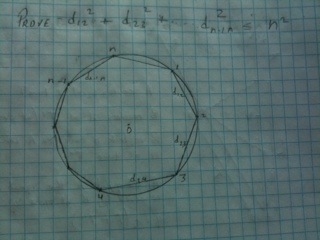 |
Consider n points lying on the Unit Sphere (the image shows a unit circle instead of a sphere). Show that the sum of the squares of the lengths of all segments determined by the n points is less than  . . |
Potential Stumbling Block
n is the NUMBER of points. It seems a bit counter-intuitive to think of the lengths of the segments related to the number of points on the unit sphere. Yet – that is exactly what this problem is asking us to prove.
Baby Steps
Perhaps the first realization should be that the sum of the squares of lengths is sought. So – we should probably think in terms of the vectors representing the segments – so that we can take an inner product (which will be a squared length).
- Let O be the origin
- Let
 be the vector connecting O and a point 1 (one of the n points). Then the vector
  (see the image below). A given segment’s length is just the difference in length of the two vectors radiating from the origin: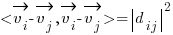
Adolescent Steps
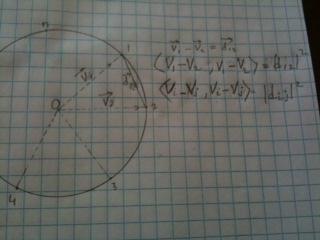
Now that we have a way to describe the length of an individual segment, let us denote by S the sum of all such segments:
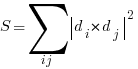
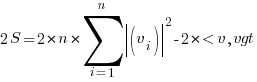
- Now, the trick is to realize that 2 times the Sum :

- Once we have the above expression for 2S, the rest is just algebra:



Final Step
The above expression shows that  . Hence,
 i.e. the sum of the squares of all segments is less than
  .
.
Anuj holds professional certifications in Google Cloud, AWS as well as certifications in Docker and App Performance Tools such as New Relic. He specializes in Cloud Security, Data Encryption and Container Technologies.
Anuj Varma – who has written 1209 posts on Anuj Varma, Hands-On Technology Architect, Clean Air Activist.


Leave a Reply