Multisig Inheritance Plan
2-of-3 Multisig Inheritance Plan — Diagram & Full Guide
This HTML document contains a complete explanation (from earlier responses) plus a clear diagram illustrating a 2-of-3 multisig Bitcoin inheritance setup, secure storage advice, and recommended trust language & operational details.
Why cryptographic keys maintain integrity (short recap)
In decentralized systems like Bitcoin there is no central authority — cryptographic keys and digital signatures enforce ownership and ledger integrity. Possession of the private key equals control of funds; public keys / addresses let others send funds; signatures verify spenders without revealing secrets.
Multisig & inheritance — the concept
A multisignature (multisig) wallet holds multiple public keys and requires a threshold (e.g., 2 of 3) of corresponding private keys to authorize a spend. For inheritance: you can hold one key, a trusted attorney/executor holds another, and the heir holds the third. Any two keys can move funds.
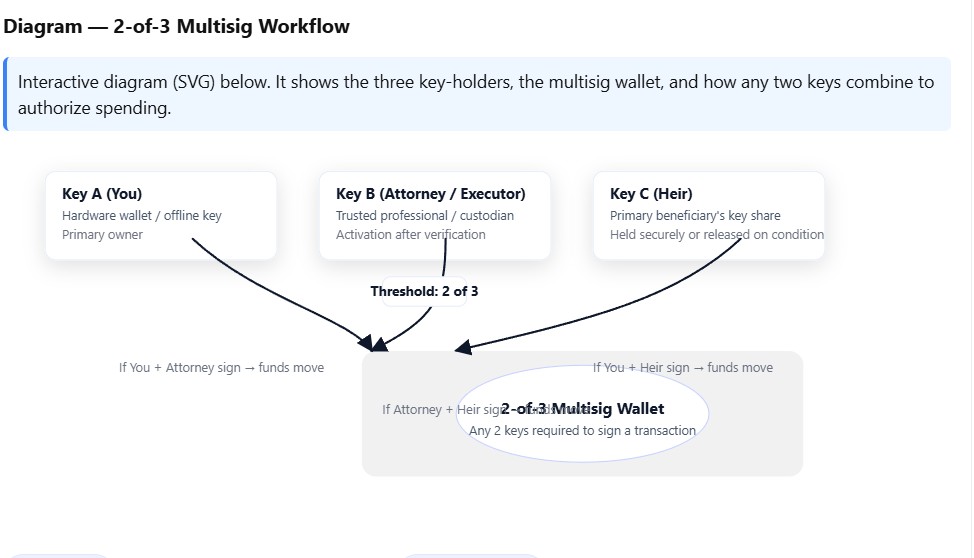
Diagram — 2-of-3 Multisig Workflow
Interactive diagram (SVG) below. It shows the three key-holders, the multisig wallet, and how any two keys combine to authorize spending.
Key A (You)
Hardware wallet / offline key
Primary owner
Key B (Attorney / Executor)
Trusted professional / custodian
Activation after verification
Key C (Heir)
Primary beneficiary’s key share
Held securely or released on condition
2-of-3 Multisig Wallet
Any 2 keys required to sign a transaction
Threshold: 2 of 3
If You + Attorney sign → funds move
If Attorney + Heir sign → funds move
If You + Heir sign → funds move
Detailed 2-of-3 plan (step-by-step)
- Choose platforms: Pick hardware wallets (Coldcard, Trezor, Ledger) and multisig-compatible software (Electrum, Sparrow, Blockstream Green, Unchained). Consider custodial multisig services (Casa, Unchained) if you want managed support.
- Generate keys securely: Prefer offline creation. Create Key A (you), Key B (attorney/executor), Key C (heir). Each on its own hardware or offline environment.
- Create the multisig wallet: Combine public keys in the wallet software to create the 2-of-3 multisig descriptor / address. Fund with a small test amount first.
- Test recovery: Perform a test spend that requires two keys to ensure everyone knows the process.
- Backups & duplication: Store at least one encrypted backup of each key’s seed/backup in a different physical location (safe deposit box, secondary safe).
Key storage recommendations
Key A (You): Hardware wallet in a home fireproof safe; backup seed in a bank safe deposit box or second safe. Consider an encrypted digital backup stored offline on an air-gapped storage device.
Key B (Attorney/Executor): Stored by the professional in their secure custody solution or vault. Ensure their agreement (written) to only release under the conditions you define (e.g., certified death certificate + ID verification).
Key C (Heir): Can be held by the heir but with instructions limiting spending before conditions are met. Alternatively, keep Key C with a trusted third party until distribution.
What to put in the trust & supporting documents
Do not put actual private keys or seed phrases in the trust document. Instead include:
- Beneficiary designations: Name who receives the crypto assets.
- High-level wallet description: Explain it is a 2-of-3 multisig and identify the key-holders by role (not by revealing keys).
- Location & access process: Reference a separate secured “Crypto Instruction Letter” that explains where seeds/backups are stored and step-by-step recovery instructions.
- Executor powers: Give the trustee authority to coordinate signing or to work with a professional custodian to consolidate and transfer assets.
- Conditions for release: E.g., proof of death, multi-factor verification, or court order if necessary.
- Replacement & update instructions: How to rotate keys or replace a key-holder if someone dies or becomes incapacitated.
Practical tips & gotchas
- Never store seed phrases in plain text inside a will — that document becomes public during probate in many jurisdictions.
- Perform a regular review (annual or biennial) to ensure key-holders, attorney, and heirs are still appropriate and able to carry out duties.
- Consider a small training session with the heir and attorney so they know the signing workflow and how to access the multisig wallet when needed.
- Test the recovery at least once (with a small amount) to ensure processes are followed correctly.
Example language snippets
Trust clause (high-level example):
"The Trustee shall, upon presentation of acceptable proof of the Settlor's death, take custody of the Settlor's digital asset holdings and follow the Settlor's separate Crypto Instruction Letter to effectuate transfer of the assets to the named Beneficiaries. The Crypto Instruction Letter is incorporated by reference but shall not be recorded in public filings. The Trustee is authorized to engage qualified technical and custodial professionals to assist in recovery and transfer."
Crypto Instruction Letter (items it should contain, kept separately):
- Name of multisig wallet software and version.
- Public keys / wallet descriptor (OK to include public information).
- Physical locations of hardware wallets and backup seed phrases (encrypted), and the locations of safe deposit boxes.
- Step-by-step steps for reconstituting the wallet, including contact details for the attorney and any service providers.
- Any PINs or passphrases required — encrypted or stored in a way that only the executor can decrypt (e.g., sealed envelope with instructions only to open upon death).
Anuj holds professional certifications in Google Cloud, AWS as well as certifications in Docker and App Performance Tools such as New Relic. He specializes in Cloud Security, Data Encryption and Container Technologies.
Anuj Varma – who has written 1274 posts on Anuj Varma, Hands-On Technology Architect, Clean Air Activist.


Leave a Reply